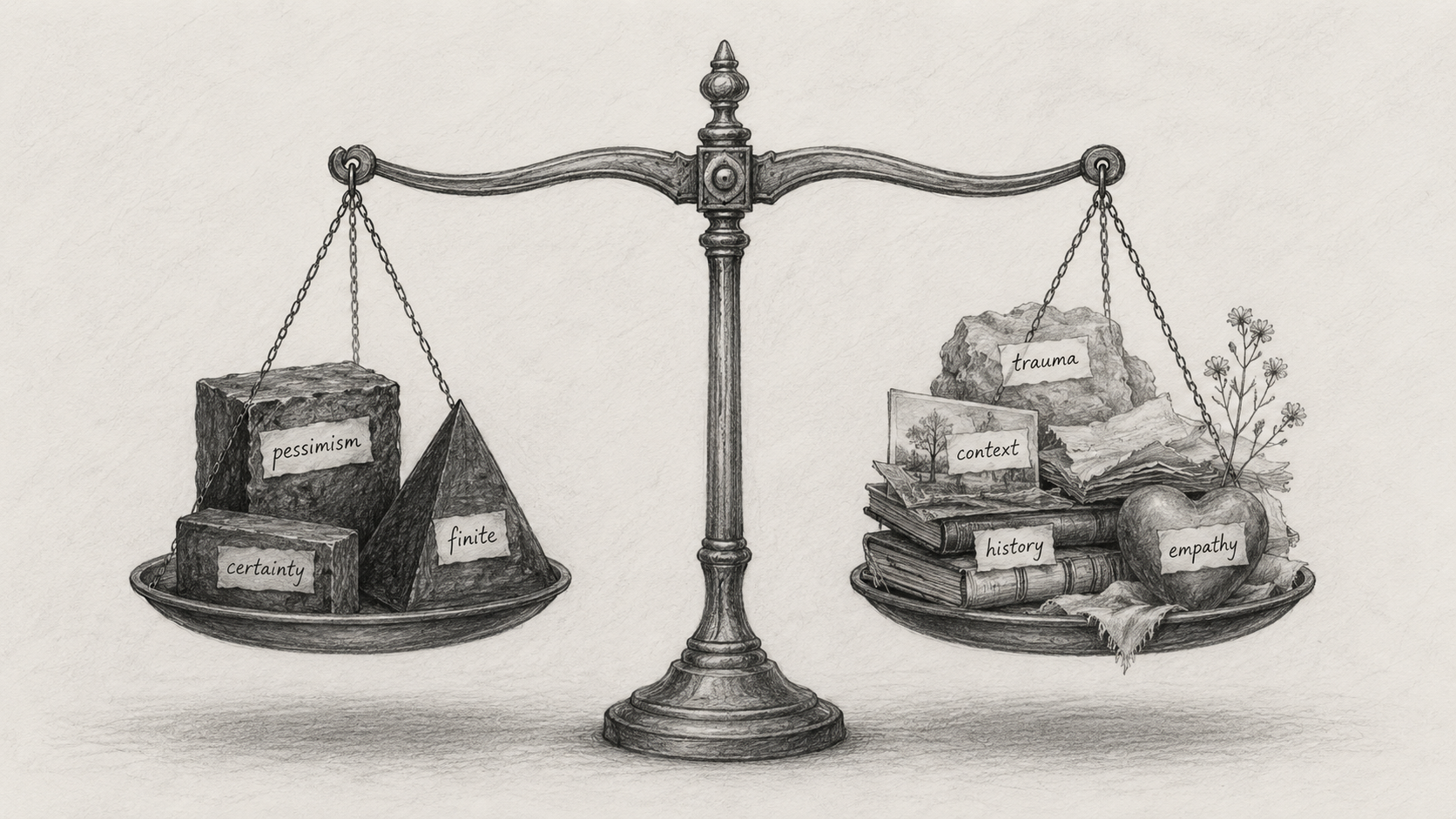
Nuance is heavy because it refuses to let truth become lazy.
It does not allow us to flatten people into good or bad, right or wrong, victim or villain. It does not let us take the easiest route to judgement and call it wisdom. It asks us to pause. To look again. To step back from the concrete arc that is so often portrayed openly by people and wonder what else sits beneath it.
And perhaps that is why so many people avoid it.
Because black and white is easier to carry.
Being nuanced as a person is incredibly difficult. From the outside, it can look like indecision. Like weakness. Like sitting on the fence. Like trying to please everyone. Like being a “sheeple,” because you are not loudly throwing yourself into one fixed corner and refusing to move.
But that is not what nuance is.
Nuance is not cowardice.
It is not over explaining because you have no backbone.
It is not over compensating because you do not know what you believe.
Sometimes nuance is the exact opposite.
Sometimes it is having such a deep sense of the bigger picture that you cannot bring yourself to flatten something just to make it easier for other people to digest.
It is seeing the layers. The history. The context. The harm. The intention. The consequence. The contradiction. The uncomfortable truth that two things can exist at once.
A person can be hurt and still hurt others.
A reason can exist without becoming an excuse.
A person can be wrong without being entirely evil.
Someone can be trying their best and still not be safe.
Something can be understandable and still unacceptable.
That is the weight of nuance.
It asks you to carry more than one truth at the same time, and people do not always like that. They often want clean answers. They want good people and bad people. Right sides and wrong sides. A villain, a victim, a sentence, a conclusion.
Nuance unsettles that.
It slows judgement down.
It asks questions where others want a full stop.
It refuses to turn human beings into cardboard cut-outs of their worst moments or their best intentions.
And perhaps that is why being nuanced can feel like a curse. Because you are always holding the extra weight. You are always seeing the grey in a world that often demands black and white. You are always trying to explain the middle ground to people who have already decided the middle ground is weakness.
But I do not believe nuance is weakness.
I believe being nuanced takes courage.
Not the loud kind of courage that roars defiantly. Not the kind that needs to be seen winning an argument. But the quieter kind. The kind that stands still long enough to ask another question. The kind that risks being misunderstood because it refuses to simplify what it knows is layered.
It takes courage to say, “I understand why, but I still do not excuse it.”
It takes courage to say, “This is wrong, but it did not come from nowhere.”
It takes courage to admit that truth can have edges, shadows, histories and contradictions.
Because black and white thinking often gives people certainty. Nuance asks you to live without that comfort. It asks you to carry doubt, empathy, anger, compassion, consequence and understanding all at once.
And that is not weakness.
That is bravery with depth.
It does make me wonder where nuance comes from.
Is it born from horrific things happening to you? Does trauma force some people to look deeper because they have lived in the layers themselves? Or is it something more personal than that? Something in character, temperament, empathy, or the way a person’s mind naturally searches for the unseen piece?
Because suffering alone does not make a person nuanced.
Some people who have suffered terribly become more black and white. And maybe that is its own survival. Maybe certainty becomes a wall. Maybe judgement becomes armour. Maybe simple answers feel safer when life has already been too complicated to bear.
And I understand that too.
Because sometimes, when life has harmed you, black and white thinking can feel like protection. It can feel like finally having a line. Finally having a rule. Finally knowing where something belongs. After chaos, certainty can look like safety.
But nuance asks for something different.
It asks us to know the line exists, while still understanding what led someone to it.
It asks us to name harm without losing humanity.
It asks us to be honest without becoming cruel.
It asks us to hold compassion without letting compassion become permission.
That is not easy.
Trauma itself is nuanced. It is not just what happened. It is what it changed. What it taught the body to expect. What it silenced. What it made someone believe about themselves, about others, about safety, about love, about trust, about the world.
It is not always visible.
It does not always behave in ways people understand.
Sometimes it looks like anger. Sometimes it looks like distance. Sometimes it looks like control. Sometimes it looks like people pleasing. Sometimes it looks like avoidance. Sometimes it looks like someone appearing fine while something inside them is still bracing for impact.
And this is where nuance matters most.
Because without nuance, we judge the behaviour without ever asking what sits beneath it. We condemn the reaction without considering the wound. We decide what someone should have done from the comfort of not having lived inside their body, their fear, their history, or their survival.
But nuance does not mean everything becomes acceptable.
That is where people misunderstand it.
Nuance is not saying nothing is wrong.
Nuance is not excusing harm.
Nuance is not letting people escape accountability because life has been hard for them.
Nuance is saying, “I can see the roots, but I can still name the damage.”
It is saying, “I can understand the wound without allowing it to become a weapon.”
It is saying, “There is a bigger picture, but the bigger picture does not erase the person who was hurt.”
And maybe that is why nuance is so difficult. Because it asks us to be fair when fairness is not simple. It asks us to keep our humanity intact when judgement would be easier. It asks us to resist the temptation to become hard, even when life has given us every reason to.
Perhaps nuance is not born from pain alone.
Perhaps nuance is what happens when pain does not manage to harden every part of you.
Perhaps it is what remains when you have every reason to become rigid, but some part of you still insists on seeing the whole picture.
And maybe that is not delusion.
Maybe it is not laziness.
Maybe it is not sitting on the fence.
Maybe it is not weakness at all.
Maybe nuance is one of the rarest forms of courage there is.
The courage to look deeper.
The courage to hold more than one truth.
The courage to be misunderstood by people who need the world to be simpler than it is.
The courage to say that life is rarely clean, people are rarely one thing, and truth is often heavier than the version we are first handed.
Because nuance is heavy.
But maybe the weight of it is proof that something in us is still willing to care enough to look beneath the surface.
Leave a Reply